Website completion review

Ugly John's Custom Boats site review

Preliminary technical findings from a live review of the public preview site at tulsalocalbusiness.com. Prepared as a factual aid for internal review, vendor discussion, or legal counsel.

Executive summary

Review date: July 29, 2026

The preview site is not launch-ready. Core buyer paths fail, financing is unclear, forms appear generic or duplicated, and the site performs poorly on mobile and desktop.

A real template and content are in place, but the site still shows broken routes, wrong-market copy, placeholder signals, and quality-control gaps. It needs correction and proof of function before launch.

Performance scoreNeeds work
Mobile50
Desktop54
First paintMobile 16.9sHow long before a visitor sees the first visible part of the page instead of a blank or loading screen.
Mobile16.9s
Desktop6.6s
Largest paintMobile 17.0sHow long before the main visible content, usually the large hero image or page section, finishes appearing.
Mobile17.0s
Desktop8.3s
AccessibilityPartial
Mobile85
Desktop79
Best practicesGaps
Mobile69
Desktop50

Why this matters: first paint and largest paint are page-speed/load signals because they describe what a real visitor feels while waiting. The mobile run is especially weak at 16.9s and 17.0s, and the desktop run is still slow at 6.6s and 8.3s. A buyer may think the site is broken, leave before viewing inventory, or lose confidence in the dealership experience.

This report is a technical review, not a legal opinion. It should be used to support questions about completion, quality, functionality, and launch readiness.

Sources reviewed: public site at tulsalocalbusiness.com, sample crawl of 75 reachable internal URLs, page source checks, and the provided PageSpeed Insights mobile report dated July 29, 2026, plus a desktop Lighthouse lab run of the same public URL.
Severity scale

The ratings below describe launch risk, not legal liability.

High

Blocks a buyer path Damages lead flow Breaks launch trust Hurts brand accuracy Creates major performance risk

Medium

Creates user friction Causes confusion Adds SEO risk Adds maintenance risk Shows quality-control gaps

Low

Visible polish issue Metadata cleanup Minor content quality issue Confidence reducer Should be cleaned before handoff

Visual evidence

Representative screenshots from the live preview site and the provided PageSpeed report.

Brand and first impression

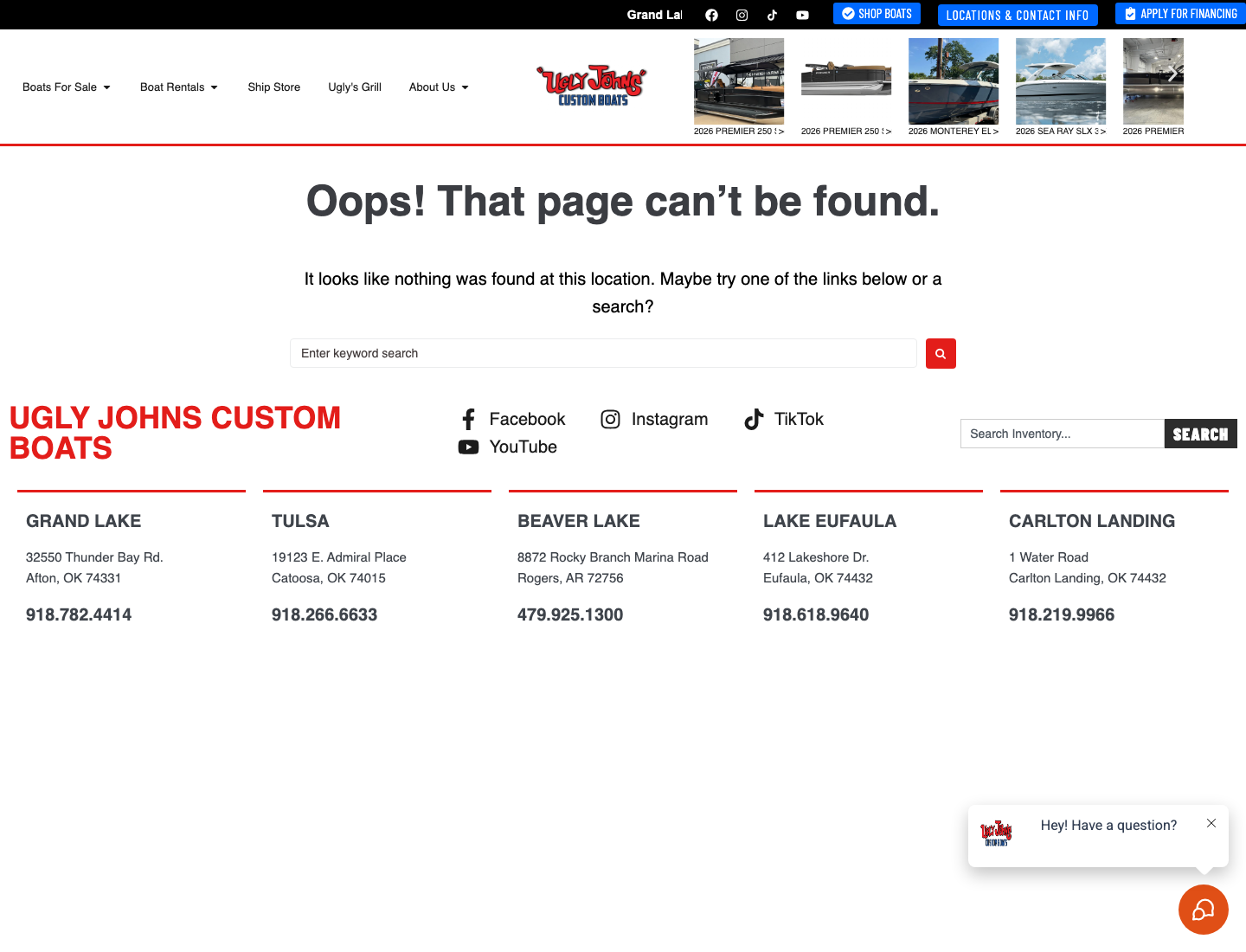
Wrong-market hero copy makes the site look unfinished.

The first viewport is the buyer's orientation point. This template has a credible boat-dealer look, but the message still references the wrong market.

Homepage screenshot showing the preview site's hero section
1Wrong-market hero copyThe visible hero says COEUR D'ALENE'S BOAT DEALER, not Ugly John's Oklahoma/Arkansas lake markets.
2Crowded orientationThe first viewport mixes product thumbnails, social links, location text, and CTAs before the core local promise is clear.

Reference: NN/g heuristic: match between system and real world.

Mobile performance

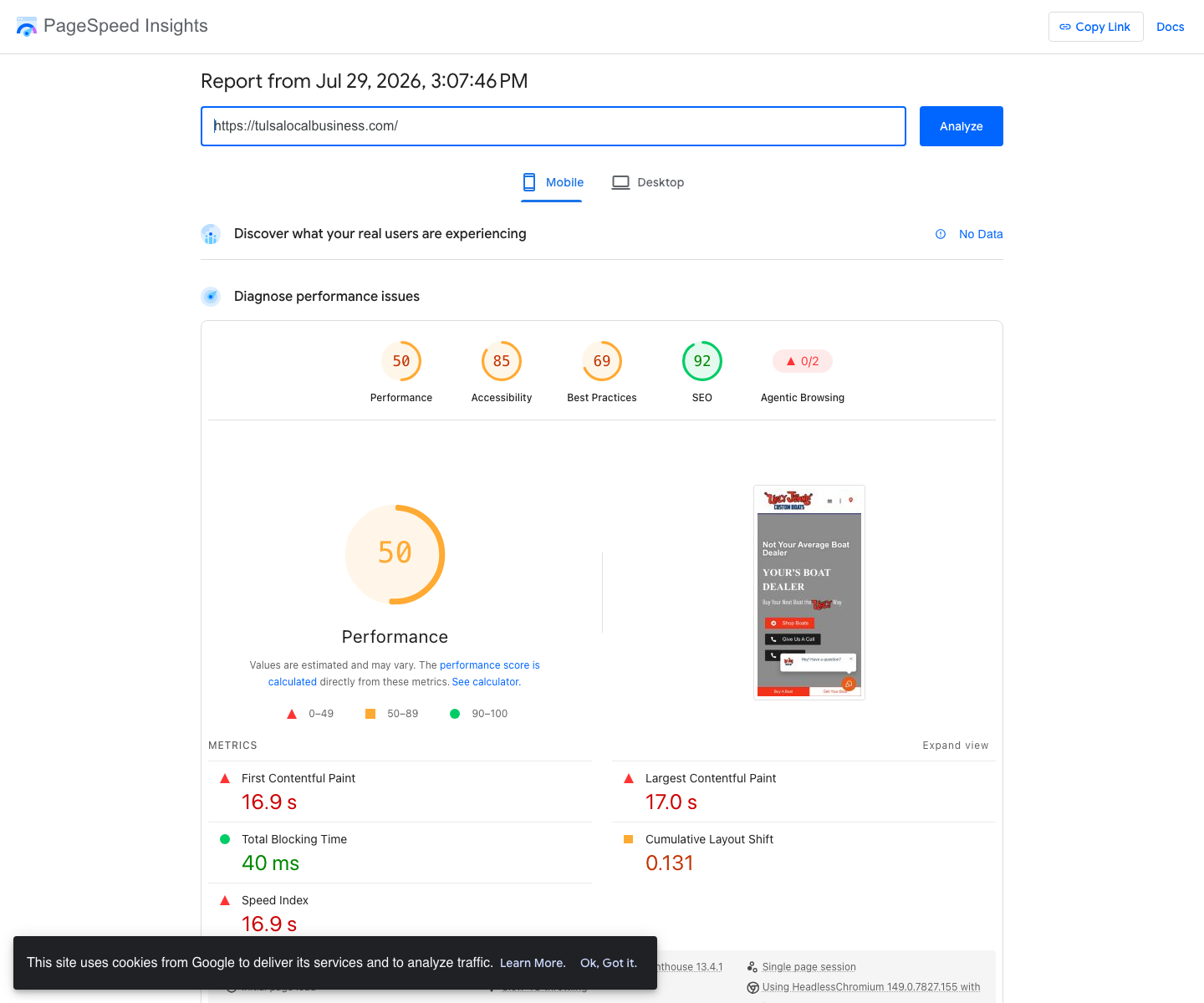
Mobile performance and PageSpeed results are not launch-quality.

For a dealership site, mobile speed is not just technical polish. It affects buyers browsing inventory, financing, rentals, and locations from phones.

PageSpeed Insights mobile report screenshot
3Performance score: 50The provided PageSpeed report shows a weak mobile lab score.
4First paint: 16.9sUsers may wait a long time before the page feels usable.
5LCP: 17.0sGoogle's good LCP threshold is 2.5s and poor threshold is 4.0s; this result is far beyond both.

Reference: web.dev Core Web Vitals and thresholds.

Buyer path

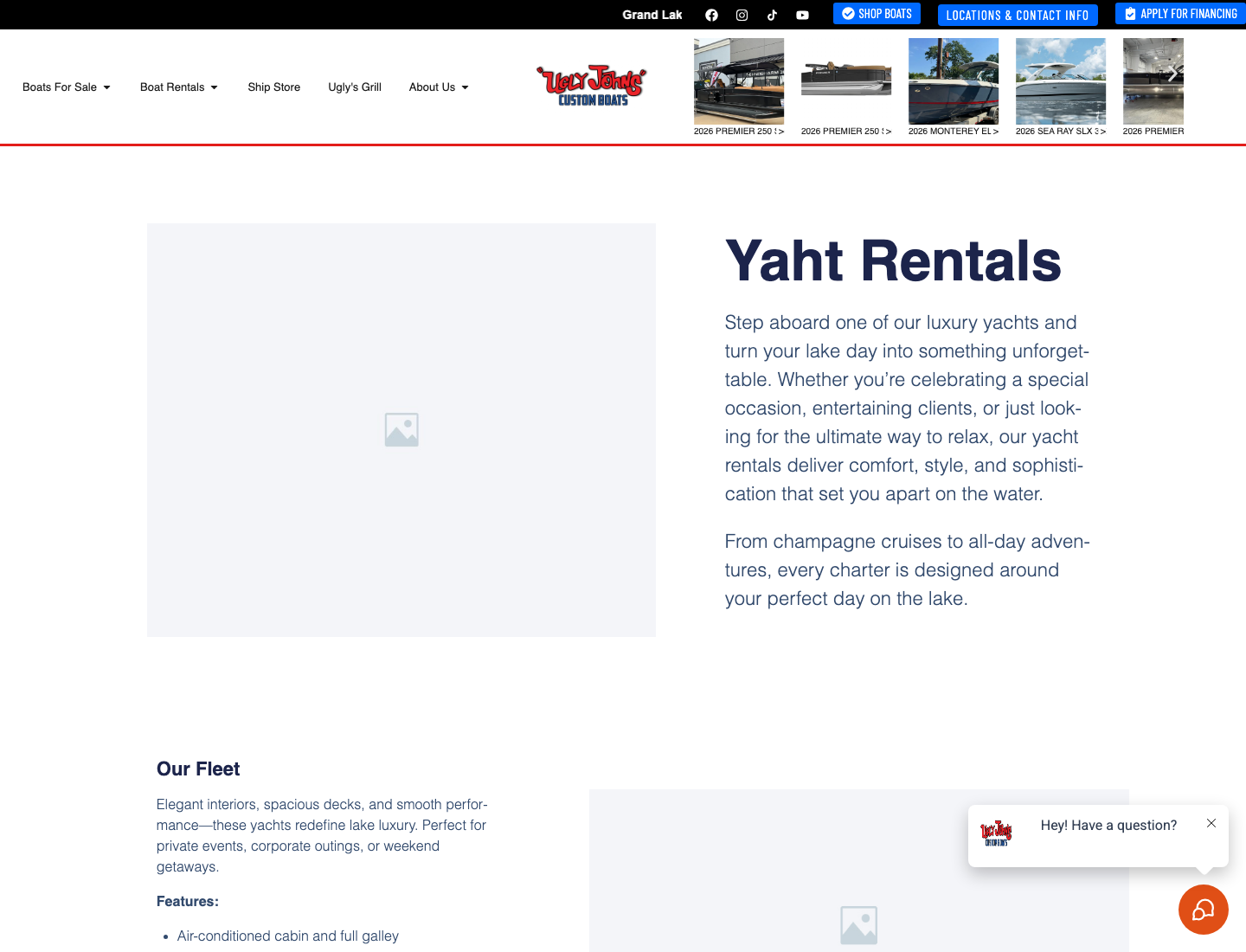
Expected financing URL leads to a page-not-found screen.

Financing is a high-value path for a boat dealership. A common URL failing here is a launch-readiness issue even if another alternate slug exists.

Financing URL screenshot showing a page-not-found response
6Expected path failsThe common /financing/ path returned a page-not-found response during review.
7Generic recoveryThe page does not clearly guide a buyer back into a working financing application flow.

Reference: NN/g error prevention and recovery heuristics.

Content quality control

Visible typo-level copy and placeholder signals reduce trust.

These issues are smaller than broken buyer paths, but they matter because the report is judging whether the site is ready to be handed to a real dealership audience.

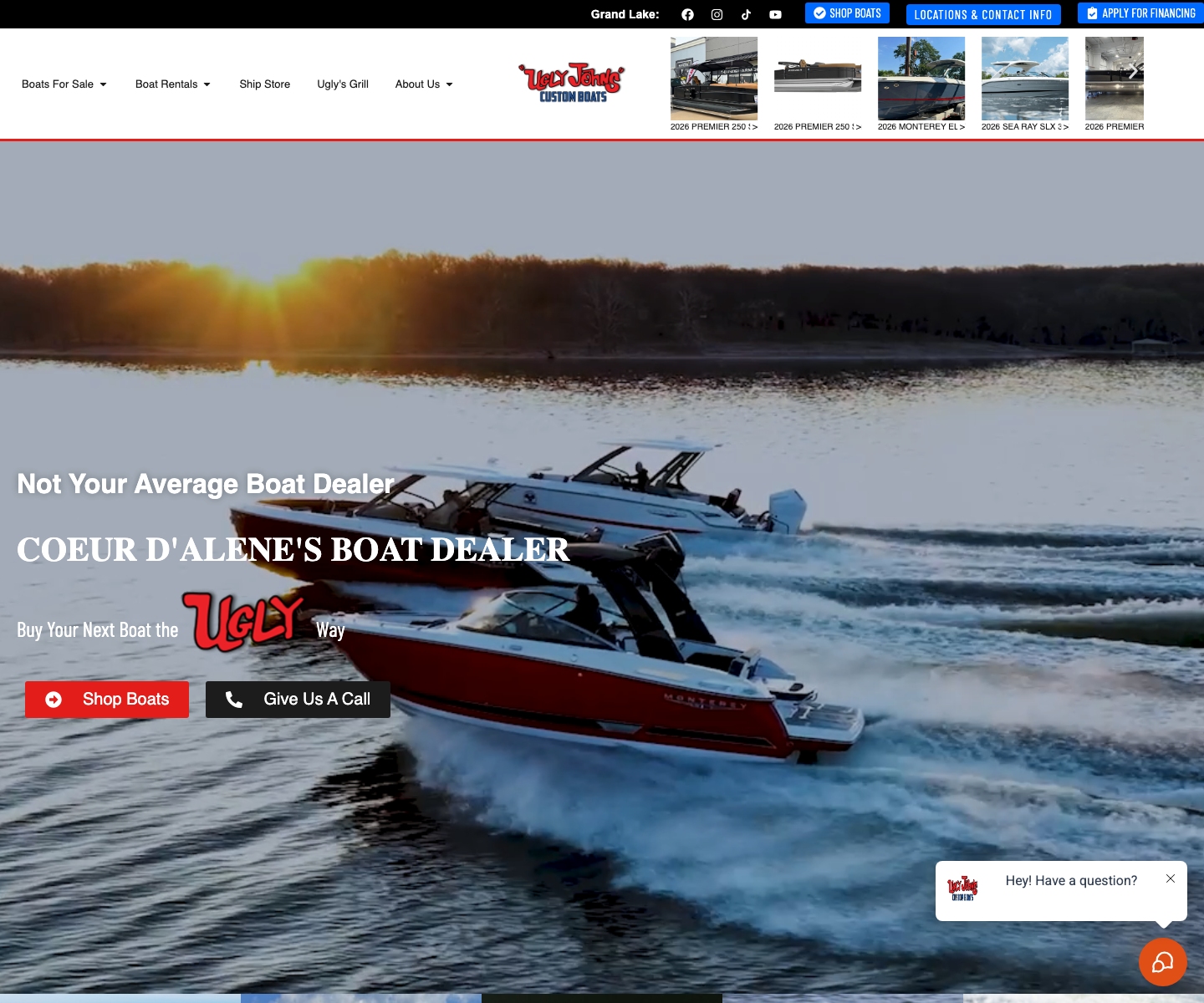
Yacht rentals page screenshot showing typo-level copy and page polish issues
8Typo-level copyThe visible heading includes Yahts / Yaht Rentals style copy, which signals missed quality control.
9Visual polish gapImage/content treatment looks incomplete enough to undermine confidence in the handoff.

Reference: Google SEO Starter Guide: create helpful, reliable people-first content.

Key findings

Findings are based on publicly reachable pages at review time.

High severity

01Common buyer-path URLs return page-not-found responses

High
Observed evidence
Requests to /financing/, /contact/, /locations/, /service/, /pre-owned, and /yacht-charters returned 404 pages during the review.
Why it matters
Even where alternate slugs exist, common paths a user, search engine, or team member would try do not resolve cleanly.
Risk basis
Cited to NN/g consistency, standards, error prevention, and error recovery heuristics. Broken high-intent URLs make users recover from preventable errors and make the site feel unfinished.

02Financing flow appears incomplete or misaligned

High
Observed evidence
The expected /financing/ path is a 404. The live financing content is under /financing-your-boat/. The page source did not show AppOne/App1 integration references during the review.
Why it matters
A high-value buyer path appears unfinished or at minimum not clearly integrated with the financing process Ugly John's needs.
Risk basis
Cited to NN/g consistency and recognition-rather-than-recall heuristics. Buyers should not need to guess the correct financing URL or wonder whether the application path is actually connected.

03Homepage exposes wrong-market and placeholder-style launch signals

High
Observed evidence
The visible hero headline says COEUR D'ALENE'S BOAT DEALER. The HTML scan also returned Loading your boat dealer... as the homepage H1.
Why it matters
A launch-ready homepage should immediately communicate Ugly John's actual market and value proposition, not another region or placeholder structure.
Risk basis
Cited to NN/g match-between-system-and-real-world heuristic and Google's SEO Starter Guide. The page should help users and search engines understand the correct business, market, and purpose.

05Mobile PageSpeed report shows launch-level performance concerns

High
Observed evidence
The provided mobile PageSpeed report shows Performance 50, Accessibility 85, Best Practices 69, SEO 92, Agentic Browsing 0/2, First Contentful Paint 16.9s, Speed Index 16.9s, and Largest Contentful Paint 17.0s. A desktop Lighthouse lab run showed Performance 54, Accessibility 79, Best Practices 50, SEO 92, First Contentful Paint 6.6s, Speed Index 6.6s, and Largest Contentful Paint 8.3s. The mobile report also shows no Chrome UX Report field data for this URL.
Why it matters
A boat-dealer site needs fast mobile buyer paths. A 17-second largest-contentful-paint result is a conversion and trust risk before launch.
Risk basis
Cited to web.dev Core Web Vitals and web.dev LCP threshold guidance. LCP should be around 2.5s for a good experience and 4.0s is already poor; the observed 17.0s is far outside that range.
Medium severity

04Pages are very large and heavy

Medium
Observed evidence
Homepage response was about 335 KB of HTML. Shop and category pages repeatedly returned about 664-676 KB of HTML before images and supporting assets.
Why it matters
Large pages can hurt mobile performance, search quality, and conversion, especially for customers browsing from marina or lake locations.
Risk basis
Cited to web.dev Core Web Vitals. Heavy pages commonly contribute to slow loading, and slow loading is especially damaging on mobile buyer paths.

06Implementation exposes front-end configuration details

Medium
Observed evidence
The page source includes a WeatherAPI key in client-side JavaScript with the comment Replace with your WeatherAPI.com key.
Why it matters
Keys and implementation comments in public page source indicate weak launch hygiene. The key should be rotated or confirmed safe for public use.
Risk basis
Cited to basic launch-readiness and security-hygiene practice: public client-side source should not contain unresolved implementation comments or keys that have not been intentionally approved for browser exposure.

07Forms appear generic or duplicated across pages

Medium
Observed evidence
Several pages contain repeated Elementor forms named Quick Credit Application and New Form. The shop page scan found 21 forms.
Why it matters
Generic form names and repeated form instances make it harder to confirm where leads go, what each form does, and whether submissions are routed correctly.
Risk basis
Cited to NN/g visibility-of-system-status and consistency heuristics. A lead-generation site should make each form's purpose and outcome clear to the user and to the business team responsible for follow-up.

08Commerce-style add-to-cart URLs appear on boat inventory

Medium
Observed evidence
The crawl found product listing URLs with query strings such as ?add-to-cart=3409 on boat pages.
Why it matters
For a dealership inventory site, buyer inquiry flows should be intentional. Cart mechanics can confuse shoppers if the business does not actually sell boats through a standard checkout flow.
Risk basis
Cited to NN/g match-between-system-and-real-world heuristic. The interface model should match the real buying process; if boats are inquiry-driven, cart URLs can signal the wrong behavior.

09Search and content structure are inconsistent

Medium
Observed evidence
Alternate routes exist for several sections: /contact-us/ works while /contact/ fails; /locations-grand-lake/ works while /locations/ fails.
Why it matters
Inconsistent URL patterns create avoidable user confusion and make migration, redirects, and SEO harder to manage.
Risk basis
Cited to Google's link and crawlability guidance and NN/g consistency heuristic. Clean links and predictable URL structure help both users and search systems navigate the site.
Low severity

10Metadata contains quality issues

Low
Observed evidence
Schema description includes typo-level text such as Yahts. A public page heading also renders as Yaht Rentals.
Why it matters
Small errors in metadata weaken confidence in quality control and can appear in search/social previews or structured-data tooling.
Risk basis
Cited to Google's SEO Starter Guide. Page content and metadata should help users and search engines understand what the page is about; typos weaken that clarity.

11Some content pages have missing or weak page headings

Low
Observed evidence
The crawl found pages such as /financing-your-boat/ and /careers/ returning no clear H1 heading in the HTML scan.
Why it matters
Clean page headings help customers, accessibility tools, and search engines understand the purpose of a page.
Risk basis
Cited to Google's SEO Starter Guide and general accessibility/content structure practice. A clear page heading supports orientation, scanning, and page-topic clarity.

Route checks

Sample paths tested live on July 29, 2026. Status 200 means the page responded. Status 404 means the page-not-found template responded.

PathStatusPage titleNotes
/200Ugly Johns Custom Boats - New & Used BoatsH1: Loading your boat dealer...
/shop/200Shop | Ugly Johns Custom BoatsAbout 672 KB HTML, 21 forms detected
/pre-owned404Page not foundExpected inventory path failed
/financing/404Page not foundExpected path failed
/financing-your-boat/200Start Financing Your Boat NowNo AppOne/App1 reference detected in HTML scan
/contact/404Page not foundExpected path failed
/contact-us/200Contact UsAlternate contact path works
/locations/404Page not foundExpected path failed
/locations-grand-lake/200Grand Lake LocationAlternate location path works
/service/404Page not foundExpected path failed
/rentals/200RentalsRental page exists, but visibility should be validated
/yacht-rentals/200Yacht RentalsH1 typo observed: Yaht Rentals
/yacht-charters404Page not foundHomepage links reference this path
/careers/200CareersNo clear H1 detected in HTML scan
/product/.../?add-to-cart=3409200Boat product pageCommerce-style cart URL surfaced in crawl

Heuristic review

Mapped to Nielsen Norman Group's 10 usability heuristics, used here as a high-level review lens.

Usability

Usability grade card

D
Overall seriousness High launch risk

The site has enough basic orientation, consistency, and recovery problems that it should not be treated as ready for a real customer launch.

Bigger pictureA boat buyer should be able to land, understand the dealership, choose a path, and recover from mistakes without guessing. The current preview creates avoidable doubt at each of those steps.
Primary driversWrong-market hero copy, broken expected URLs, inconsistent route patterns, crowded first viewport, and generic 404 recovery.
Business impactLost trust, abandoned financing/contact paths, lower confidence from staff or counsel reviewing the build, and a higher chance that launch creates support work instead of leads.
HeuristicObserved issueWhy it makes the site less usable
Match between system and real worldHomepage hero references Coeur d'Alene instead of Ugly John's actual markets.Users should see language and context that matches their dealership, region, and buying intent.
Consistency and standardsCommon URLs such as /financing/, /contact/, /locations/, and /service/ fail while alternate slugs work.Users and search engines expect familiar paths to resolve or redirect cleanly.
Error preventionBuyer-path 404s remain reachable on a public preview domain.A launch checklist should catch broken high-intent routes before customers do.
Recognition rather than recallFinancing, contact, service, and location paths are inconsistent enough that users have to guess the right slug.Customers should not need to remember the site's internal naming pattern to reach core actions.
Aesthetic and minimalist designThe first viewport stacks navigation, product thumbnails, social links, location label, and CTAs before the offer is clear.Visual density competes with the main message and can slow decision-making.
Help users recognize and recover from errors404 pages show a generic page-not-found message rather than a guided recovery path for financing/service/contact needs.When a buyer hits an error, the site should guide them to the right next action.

SEO and marketing review

Why the technical issues matter commercially, not just cosmetically. Framed against Google Search Central SEO guidance, crawlable-link guidance, and Core Web Vitals.

SEO

SEO / marketing grade card

C-
Overall seriousness Material growth risk

The site has enough content, routing, and mobile-performance issues to weaken discovery, paid/organic conversion, and local-market credibility.

Bigger pictureA dealership website is a lead engine. Search visitors, ad traffic, and returning customers need fast pages, correct market signals, and reliable conversion paths.
Primary driversMobile LCP at 17.0s, wrong-market hero copy, thin/duplicated location context, broken common URLs, weak headings, typo-level metadata, and unclear form routing.
Business impactLower trust from search visitors, weaker local relevance, wasted ad clicks, poor lead attribution, and reduced confidence that inquiries reach the right team.

Search visibility risks

  • Broken common URLs and inconsistent slug patterns make crawling, redirects, and future migration harder to manage.
  • Wrong-market hero copy and typo-level headings reduce relevance signals and damage trust when a search visitor lands on the page.
  • Missing or weak H1 headings on content pages make the page purpose less clear to users and search systems.
  • Duplicate or thin location content weakens local search value for a multi-location dealer competing around lake-specific searches.

Lead-generation risks

  • Financing, quote, trade, service, rental, and contact flows should be treated as revenue paths, not secondary pages.
  • Repeated generic forms such as New Form make it difficult to confirm where each lead goes and who owns follow-up.
  • Commerce-style ?add-to-cart= URLs can signal the wrong buyer behavior if boats are not meant to be purchased through checkout.
  • Slow mobile performance creates a direct conversion risk for shoppers browsing from phones, marinas, docks, or lake houses.

Launch and migration risks

Additional factual items that affect whether a replacement site can safely go live.

Migration

Current public site facts that matter during replacement

  • The existing public site environment is tightly connected to DealerSpike: CMS, lead forms, financing links, modal widgets, and footer vendor credit.
  • Observed lead forms on the existing site used empty form actions with DealerSpike form identifiers, so lead routing must be proven before cutover.
  • The existing sitemap showed stale last-modified dates from 2020, ghost pages, and a malformed concatenated URL ending in uglyjohns.comhttps://twitter.com/UglyJohns.
  • The existing site loaded dated front-end scripts including jQuery 1.10.2 and used mobile viewport settings that disable pinch zoom.

Location and local-SEO facts that should be fixed, not carried forward

  • Seven location, marina, and storage pages measured as roughly 95-100% duplicate content in the crawl sample.
  • Location pages were thin: mostly hours, map, and contact button, with little detail about slips, fuel, storage, service capability, food, or lake-specific buyer questions.
  • A replacement site should have unique location pages, a redirect map, working lead destinations, validated inventory paths, and a final launch checklist.
  • These items are not cosmetic. They affect search, customer trust, service routing, and whether the business owns a clean web presence after migration.

What should have been ready

High-level launch standard for a dealership website, stated without assuming contract terms.

Buyer paths

  • Inventory should be easy to browse by new, pre-owned, brand, category, location, and salesperson where relevant.
  • Contact, quote, financing, trade, service, rentals, and location pages should work at common URLs or redirect cleanly.
  • Every form should have a clear purpose, owner, destination, confirmation behavior, and test submission record.

Launch controls

  • Performance should be checked on mobile before public launch, especially for heavy inventory and image pages.
  • Copy, headings, metadata, images, and structured data should be proofed for wrong-market text, placeholder content, and typos.
  • DNS, redirects, sitemap, analytics, search indexing, security hygiene, and certificate status should be documented before cutover.

Reference standards

External standards used to explain why the observed issues matter.

Nielsen Norman Group: 10 Usability Heuristics — used as the lens for consistency, error prevention, recognition, and real-world language.

Google Search Central: SEO Starter Guide — Google frames SEO as helping search engines understand content and helping users find and decide whether to visit a site.

web.dev: Core Web Vitals and Core Web Vitals thresholds — LCP is a loading-performance metric; 2.5s is good and 4.0s is poor, compared with the observed 17.0s mobile LCP.

W3C WCAG Resize Text understanding — users should be able to scale text up to 200% without loss of content or functionality; prior migration checks found viewport settings that blocked normal zoom behavior on the existing public site.